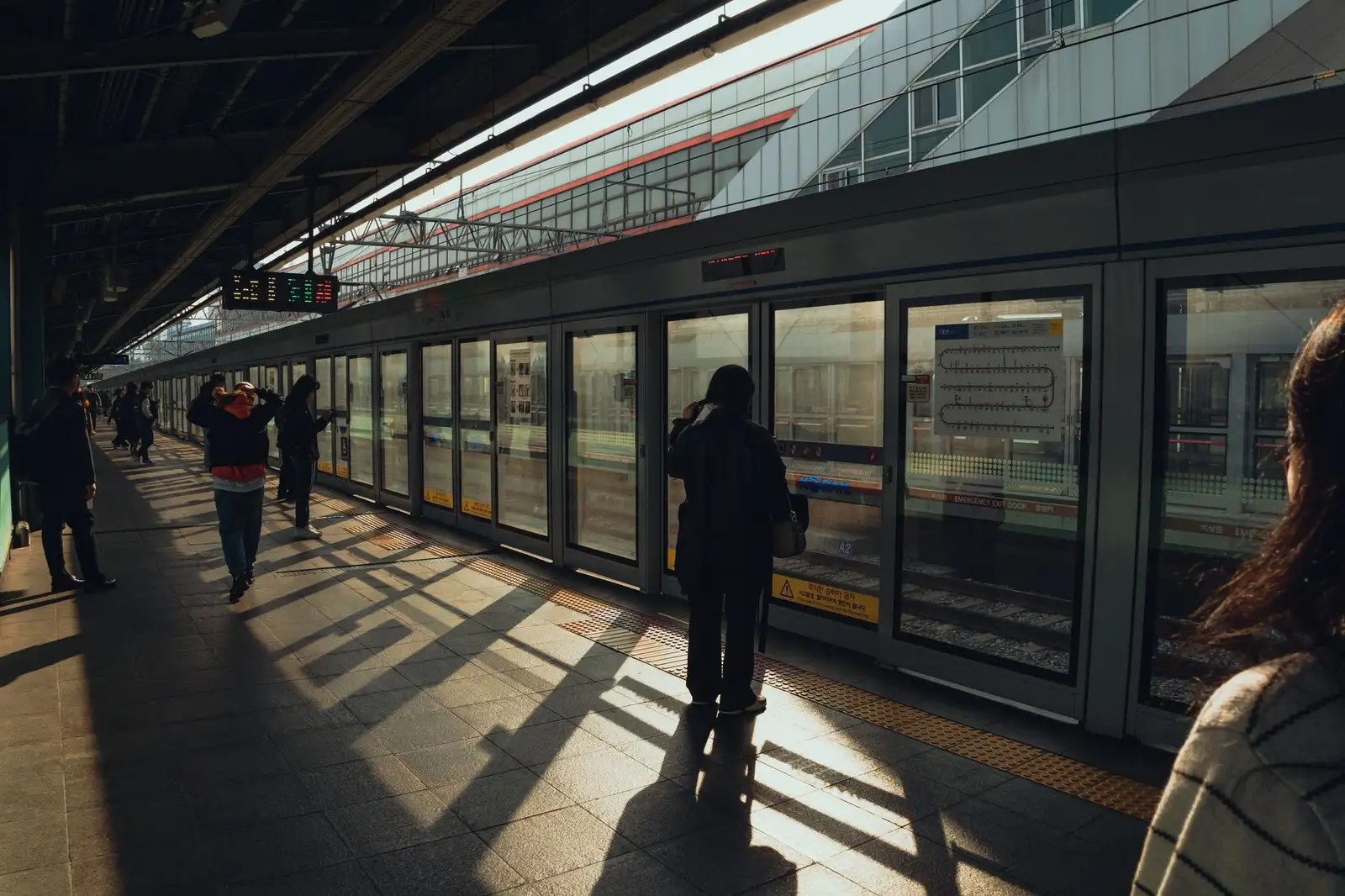

Six-thirty in the morning at Sindorim station, and the platform already smells like coffee from the GS25 convenience store near the turnstiles. A woman in a camel coat stands at a painted yellow rectangle on the floor, one of dozens of queue markers, and scrolls through her phone without looking up. The train arrives in exactly three minutes and twenty seconds, which is what the digital display said it would be. She steps in without breaking stride. Nobody speaks.
That's the thing about Seoul's commute that takes outsiders a while to read. It's extraordinarily organized and deeply private at the same time. Both things are true, and they're not in conflict.
The Infrastructure First
Seoul's metropolitan subway system carries somewhere around seven to eight million passengers on an average weekday. (The exact figures shift depending on the year and which lines you're counting, but the scale is consistently staggering.) There are nine main lines operated by Seoul Metro, plus AREX to the airport, plus the Sinbundang Line, the Gyeonggang Line, connections to Gyeonggi Province... it sprawls. If you want to understand how the city actually works as a living system, the Seoul Metro website offers route maps and real-time service updates that are useful rather than decorative.
What matters more than the numbers, though, is the culture that has grown up around this infrastructure over decades. The subway opened in 1974 with a single line. What exists now is less a transit system than a parallel city: underground malls, hospitals, sleeping lounges, and enough food stalls to constitute a meal plan.
For visitors trying to understand how transportation integrates into daily life across different cultures, this framework on local transportation is worth reading before you arrive anywhere new. Seoul specifically rewards people who understand the unspoken logic before they board.
The Queue as Social Contract
Here's something worth paying attention to before anything else: the yellow painted lines on subway platforms.
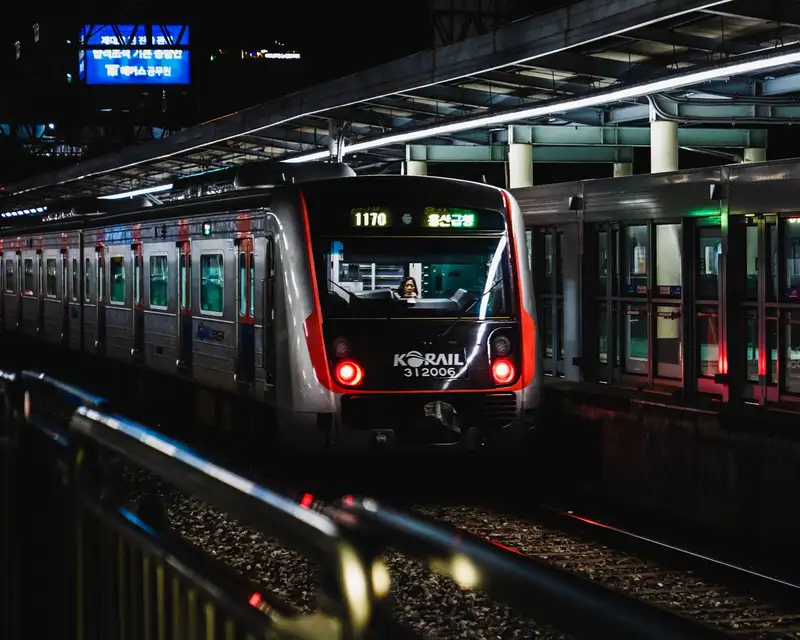
Every platform has them. They mark exactly where the train doors will open, and they direct passengers into two parallel lines on either side of the door: meaning people exiting the train have a clear path between the two boarding lines. This isn't enforced by anyone. There are no transit employees standing there pointing. It happens, reliably, at six in the morning and at eleven at night.
Watching it work is disorienting if you're used to transit systems where boarding is essentially a competitive sport. In Seoul, the queue holds. Even when a platform is crowded enough that you can feel the collective body heat, the lines stay intact. People step back to let others off before stepping on. It's not performative politeness; it's closer to muscle memory. A social script that everyone learned somewhere and nobody has to think about anymore.
I've watched this at Hongdae, at City Hall, at Gangnam, and the pattern holds across all of them. What changes is the pace. At Gangnam during the morning rush, the whole choreography accelerates: faster exits, faster boarding, but the structure itself stays the same.
What the Phone Actually Does Here
About eighty percent of the people on any given train car are looking at their phones. This is true of commuters everywhere now, but Seoul has its own version of it.
A lot of people are watching full television episodes. Not clips: full dramas, variety shows, the kind of content that in other countries people save for home. The data infrastructure here makes this easy. Korea consistently ranks among the world's highest for mobile internet speeds, and the subway has nearly complete 5G coverage, including underground. So watching a fifty-minute drama on the commute home from Mapo to Nowon isn't aspirational. It's Tuesday.
There's another layer, though. The phone also functions as a social shield. On a train where eye contact between strangers is unusual, where conversation between non-acquaintances almost never happens, the phone gives everyone a plausible reason to be looking elsewhere. It's not rudeness. It's more like a shared agreement about what kind of space a subway car is: and that agreement is that it's private space that happens to be shared.
The Quiet Car Problem That Isn't Really a Problem
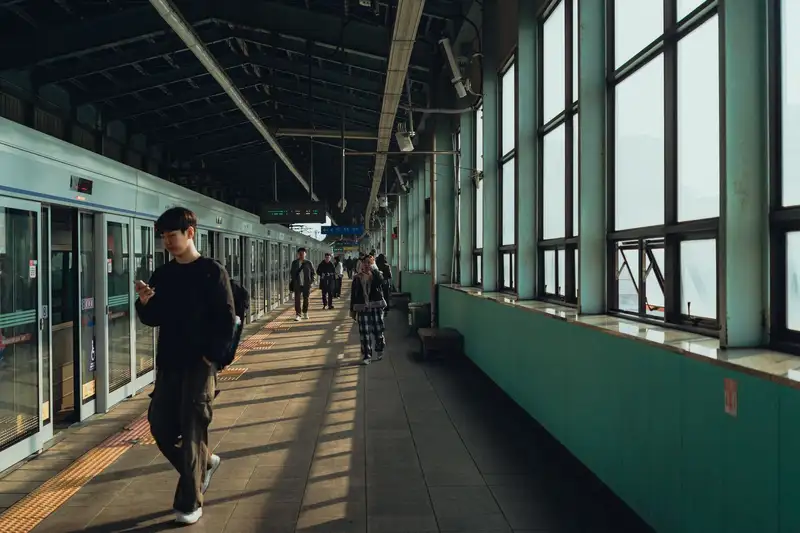
Seoul Metro has designated "quiet zones" in some cars, particularly on longer lines. But honestly, the whole system trends quiet. Not library-quiet; there are phone calls, there's music leaking from earbuds, there's the occasional group of school students being school students. But the baseline volume is lower than you'd expect for a system this crowded.
Talking on speaker phone is frowned upon. It happens, but people notice. Eating on the subway is technically discouraged and practically rare; you might see someone with a convenience store coffee, but a full meal is unusual enough to register.
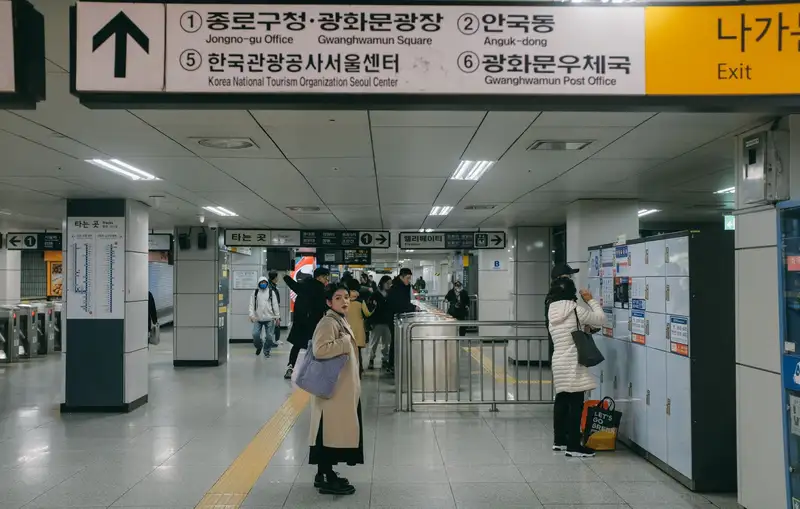
What you do hear, constantly, is the station announcement. Seoul Metro uses a four-language announcement system on most lines: Korean, English, Chinese, Japanese. The English announcements have a particular cadence that anyone who has lived in Seoul for more than a few months can probably recite from memory: "The next station is... Euljiro 3-ga. Exit for... Lotte Department Store..." There's something almost meditative about it after a while.
Rush Hour, and What Efficiency Actually Looks Like
The morning peak runs roughly from 7:30 to 9:00. The evening peak, from around 6:00 to 8:00. During these windows, trains on Lines 2, 4, and 9 in particular reach densities that feel, to the uninitiated, like a physical impossibility.
Line 9, which runs express between Gimpo and Sinnonhyeon, is the one that tends to get mentioned first when Seoulites talk about commute stress. It serves the Yeouido financial district and connects to Gangnam, which means it carries a disproportionate share of office workers with long commutes. The express cars during rush hour are intense.
And yet. The system absorbs this. Trains run every two to three minutes on major lines during peak hours. If you miss one, there is another in under three minutes. This changes the psychological texture of the commute in ways that are hard to fully appreciate until you've experienced transit systems where missing a train means a fifteen-minute wait in the cold. There's less urgency here. Less running. People walk quickly but rarely sprint.
The UNESCO framework for urban cultural heritage occasionally touches on how infrastructure shapes social behavior over generations, and Seoul's subway is a case study in exactly that, a system so reliable that it has actually changed how people relate to time and to each other in public.
The Bus Layer
The subway gets most of the attention, but Seoul's bus system runs parallel to it and in some ways is more interesting to observe from a cultural standpoint.
Buses are color-coded by function: blue for long-distance trunk routes, green for local neighborhood loops, red for express routes to satellite cities, yellow for the circular city-center routes. This system was redesigned in 2004 and is considered one of the more successful urban transit reorganizations of the past few decades.
On buses, the social dynamics shift slightly. There's more interaction: not conversations between strangers, exactly, but more acknowledgment. People make brief eye contact when someone elderly boards and everyone shifts to create an aisle. The priority seating areas near the doors (marked in a different color, usually pink or blue) are taken seriously. A young person sitting in priority seating while an older person stands nearby is the kind of thing that generates a pointed silence.
This matters because it points to something about Korean social structure. Age-based hierarchy, deeply embedded in the language itself through formal and informal speech levels, plays out physically in transit space. It's not a rule posted on a sign. It's an expectation carried in people's bodies.
Eating Around the Commute
The commute itself is mostly food-free, but the edges of it are saturated with eating.
At major interchange stations (Sindorim, Konkuk University, Sadang) there are underground food courts and convenience stores that see their peak traffic between 7:00 and 8:30 in the morning. Not for sit-down meals. For gimbap triangles, egg sandwiches, canned coffee, cups of instant ramen eaten standing at a counter. The speed is part of the ritual. Nobody lingers.
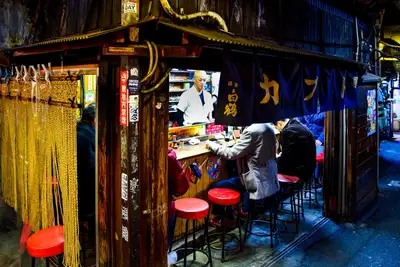
Evening is different. After the work day, especially on Fridays, the area immediately outside subway exits becomes gathering space. Pojangmacha (the tent-covered street stalls that sell tteokbokki, odeng, fried items) position themselves near station exits for exactly this reason. The commute home becomes, for some people, a slow drift through several small stops rather than a direct line from office to apartment.
This is worth understanding if you're trying to read the city's food rhythms. The commute isn't only transit; it's the frame around which eating, socializing, and transitioning between roles (worker, family member, friend) actually happens. If you're thinking about how to plan around meal timing and local rhythms in general, this travel budget framework makes the point that understanding local cadence, including when and where people eat, affects practical decisions more than most people expect.
The Gendered Texture of the Commute
This is something that often goes unmentioned in general transit guides, but it's part of the actual experience.
Seoul Metro operates women-only cars on all lines during rush hours: typically the first and last cars of each train. The policy was introduced in 2016 (on a trial basis on some lines) in response to concerns about groping and harassment. The cars are clearly marked. They're not always full; some women use them consistently, others don't.
What's interesting is how little this is discussed openly. It exists, it's used, and most people treat it as unremarkable. Which is itself a data point about how cities absorb these accommodations into daily life.
Women commuting alone late at night: this is common, and Seoul has relatively high rates of women reporting they feel safe using public transit at night compared to many cities of comparable size. That said, "relatively safe" and "without incident" are different things, and the women-only car policy suggests the city has acknowledged this gap between perception and experience.
What Visitors Often Misread
The efficiency of Seoul's transit can look, from the outside, like coldness. Strangers don't talk. Nobody smiles at you. The lines form automatically and people stare at their phones and the whole thing moves like a machine.
But I think that reading misses something important. The care is there; it's hidden.
The person who steps aside to let you figure out the ticketing machine without hovering. The station attendant who, when you look lost at a transfer point, will walk you to the correct platform rather than just pointing. The way the queue reforms itself after a disruption, without anyone asking it to. These are forms of consideration. They're quiet.
There's also the matter of what the commute reveals about the pace of Seoul life more broadly. This is a city where people work long hours, Korea's average annual working hours are among the highest in the OECD, and the commute is one of the few unscheduled parts of the day. It belongs to the individual. The phone, the earbuds, the closed eyes on a train heading toward Suseo, these aren't antisocial. They're protective.
A Few Practical Things Worth Knowing
The T-money card loads at any convenience store and covers the subway, bus, and some taxis. Transfers between subway and bus within thirty minutes are free if you tap out and tap in with the same card, this is a detail that changes how you move through the city once you understand it.
Elevator access at stations varies more than you'd expect for a system this modern. Some older stations have very limited elevator infrastructure, which matters if you're traveling with luggage, a stroller, or mobility limitations. The Metro's accessibility map is worth checking before you assume.
Platform screen doors on most Seoul Metro lines prevent falls and reduce the noise from arriving trains significantly. This is one reason the platforms feel calmer than many European or North American subway systems, the sound design is genuinely different.
The Longer View
Some operators focused on cultural immersion, Culture Discovery Vacations is one example, pay attention to transit precisely because it's where daily life is most legible. Not as a logistics problem, but as a lens. How a city moves its people tells you about what the city values: time, hierarchy, privacy, collective consideration.
Seoul's answer to all of those is complicated and interesting. The efficiency is real, not aspirational, actually real. But it sits alongside a very particular social code about personal space, about age and deference, about the shared agreement that public space can be simultaneously crowded and private.
Try This
On your first full day in Seoul, take Line 2, the green circle line, during the morning commute. Not to get anywhere specific. Ride it for two stops and pay attention to the platform before the train comes.
Watch where people stand. Watch how the lines form. Watch what happens when the doors open and the people inside need to get out before anyone can board. Then watch it happen again at the next station.
You don't need to understand Korean to read what's happening. The whole thing is written in behavior.


Comments (0)
No comments yet. Be the first!