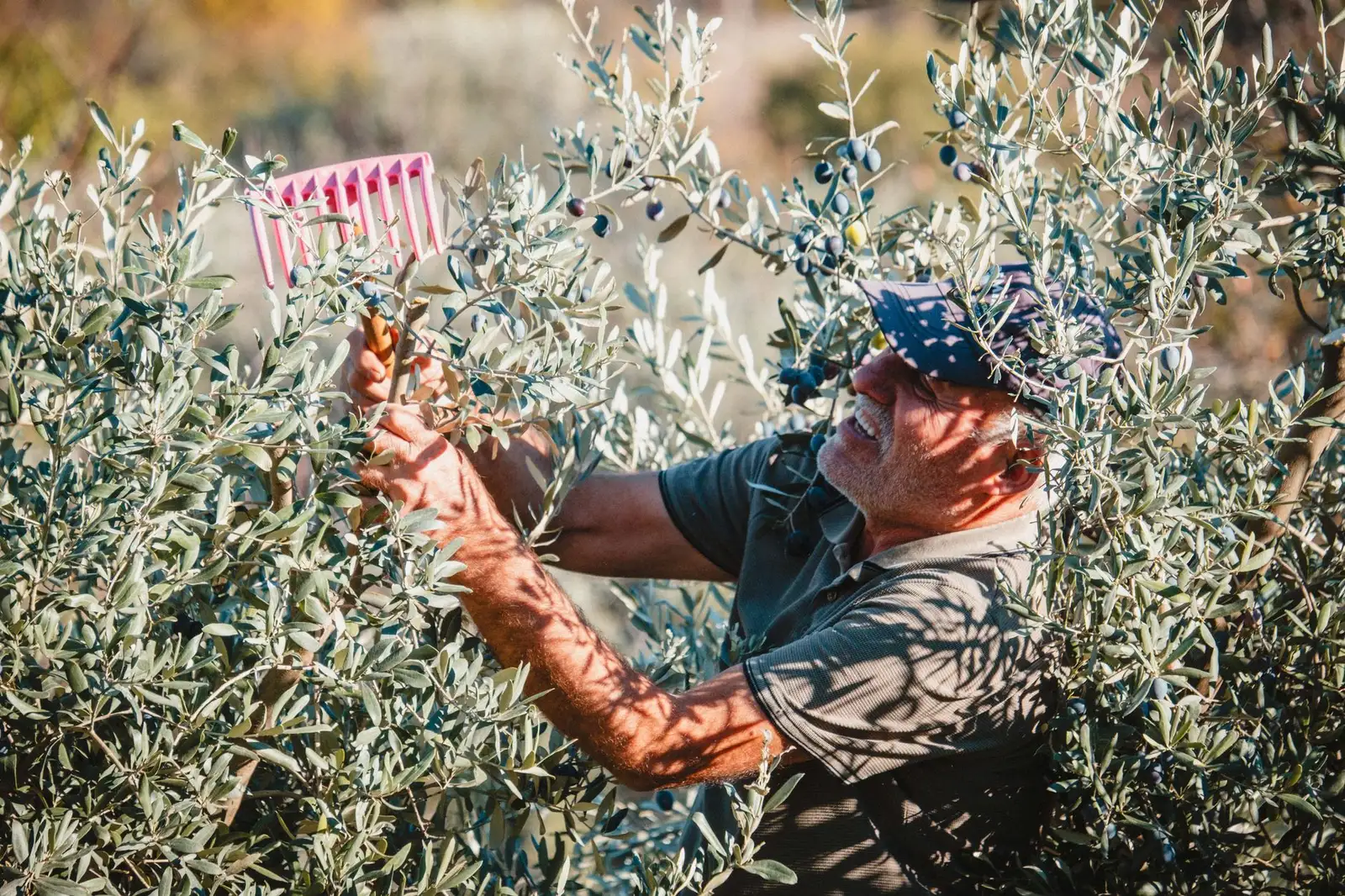

On a cold morning in early November, the first sound in the olive grove is plastic. Long green nets get shaken out and dragged under the trees, one edge tucked against the trunk, the other pulled wide across the grass. Somebody fixes a ladder. Somebody else has already started on the low branches, running a small hand rake down each one so the olives rain onto the net with a sound like hail on a tent.
By ten the sun is up over the hills, jackets are off, and the first crates are full.
This is the olive harvest in Tuscia, the old name for the land around Viterbo in northern Lazio. It runs up into the Cimini hills, the green, volcanic ridge around Monte Cimino and Lake Vico. Towns like Soriano nel Cimino, Vitorchiano and Vetralla sit on its slopes and at its feet. People here grow grapes, chestnuts and hazelnuts too. But in late autumn, for a few weeks, the olive comes first.
A small grove, a big job
Most family groves in this part of Tuscia are not large. A few dozen trees. A hundred, maybe. Some families have a plot that came down from a grandfather, on a slope too steep for anything else. Others look after an old aunt's trees as well as their own.
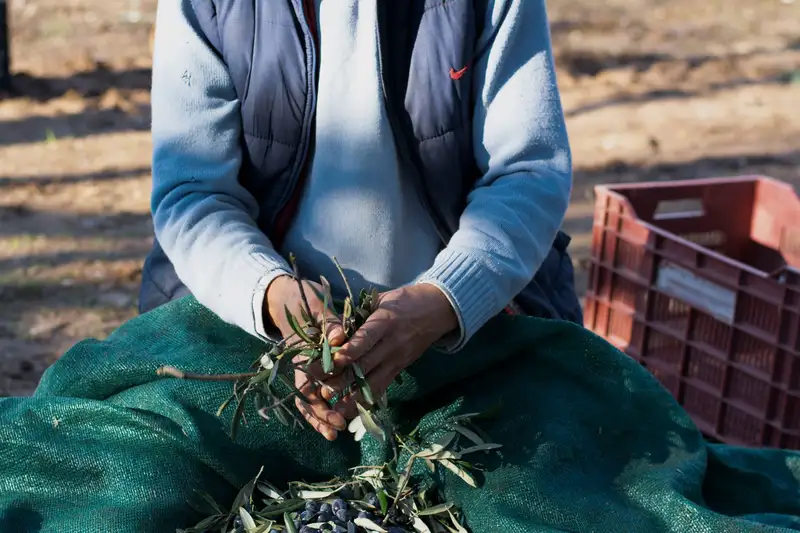
Small does not mean light work. Every tree has to be picked, and most of it is still done by hand or with simple tools. That is why the harvest pulls in the whole family. Sons and daughters come back from Rome for a weekend. Cousins show up with their own ladders. Kids carry crates. Grandparents who no longer climb still sort leaves out of the nets and tell everyone they are doing it wrong.
Ask a family how many days it takes and the answer is usually "it depends." On the weather. On the year. On how many people can come.
When to pick
In Tuscia the harvest usually starts in late October and runs through November. Some families start sooner, some go into December. There's no single day. People watch the fruit.
Olives start green. As they ripen, they turn purple and then black. Pick early, when most are still green or just turning, and you get less oil, but it's sharper and more bitter and peppery, and it keeps well. Wait longer and you get more oil that tastes softer. Every family has a view on this, and the view tends to be firm.
Weather has its say too. Heavy rain makes the ground a mess and the nets heavy. A hard frost on fruit still on the tree can hurt the oil. So when there is a good run of dry days, people take time off work and go.
Some years there is barely anything to pick. Olive trees often bear heavily one year and lightly the next. A pest called the olive fly can spoil much of a crop in a bad season. When this happens, families still go out and pick what there is. A thin year is part of the deal.
How the picking works
The basic kit has not changed much in a long time. Nets. Ladders. Crates. Hand rakes, often plastic now, that look like big combs. Some people use long poles with a shaking or combing head on the end, powered by a battery or a small motor, to reach the top of the tree. A few larger groves bring in machines that grip the trunk and shake the whole tree at once. In a family grove of old trees on a slope, that's rare.
The work has a rhythm. Lay the nets. Strip the low branches by hand. Get up the ladder for the middle. Use the pole for the top. Then everyone grabs the edges of the net and lifts, so the olives roll to the middle. Pick out the twigs and leaves. Tip it all into crates. Move the nets to the next tree.
The talk while you work is half the reason people come. Somebody's new job. A football result. What so-and-so said at the bar. Who got married, who is ill. If you join a family for a day, you'll hear a lot about people you will never meet, and that is a kind of welcome.
Lunch can be in the grove or back at the house. In the grove it's simple: bread, cheese, salami, maybe some cold pasta, wine in a plastic bottle. Back at the house it can turn into a real meal, and then the afternoon's picking starts a bit late.
Why the olives can't wait
Every family knows this: once an olive is off the tree, the clock starts.
Picked fruit begins to change fast. Bruised or crushed olives, or ones left sitting in a warm pile, start to ferment and spoil. That shows up as off flavors in the oil. So the crates don't sit for a week in the shed. Most families try to get their olives to the mill within a day or so.
That is why harvest days end in the car or the truck, with crates stacked in the back, and a drive down the hill to the frantoio.
The frantoio
The frantoio is the olive mill. In the weeks of harvest, it's one of the busiest places around. Some run day and night. You see small trucks, little three-wheel vans and family cars lined up outside, each with a load of crates and a name on a slip of paper.
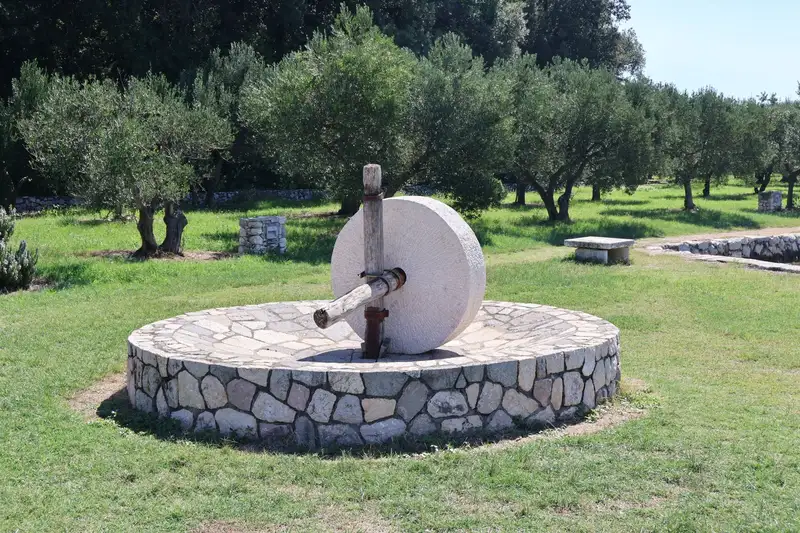
Inside, it's warm and loud and smells green. The olives are weighed first. Then they go through the steps of the mill. They're washed and the leaves are blown out. They're crushed into a paste, by stone wheels in some old mills, by steel in most new ones. The paste is mixed slowly for a while. Then a machine spins the oil out of the paste and away from the water.
You'll see signs and hear the words estratto a freddo, cold extracted. It means the paste was kept below a set heat while it was worked, which helps keep the flavor and the good stuff in the oil.
Many small families have their own olives milled on their own. They wait, watch their crates go in, and take home the oil from their own trees. That waiting is a big part of the day. People stand around and talk. They compare. They ask the miller how the year looks. Everyone wants to know their yield, how much oil came out of how many kilos of olives, and everyone has an opinion about why theirs was higher or lower than the neighbor's.
At the end, the new oil comes out of a spout. It's bright, almost neon green, and cloudy. It flows into steel cans the family brought from home.
Bread, fire and the first taste
At many mills there is one more step that has nothing to do with machines. Somebody toasts bread.
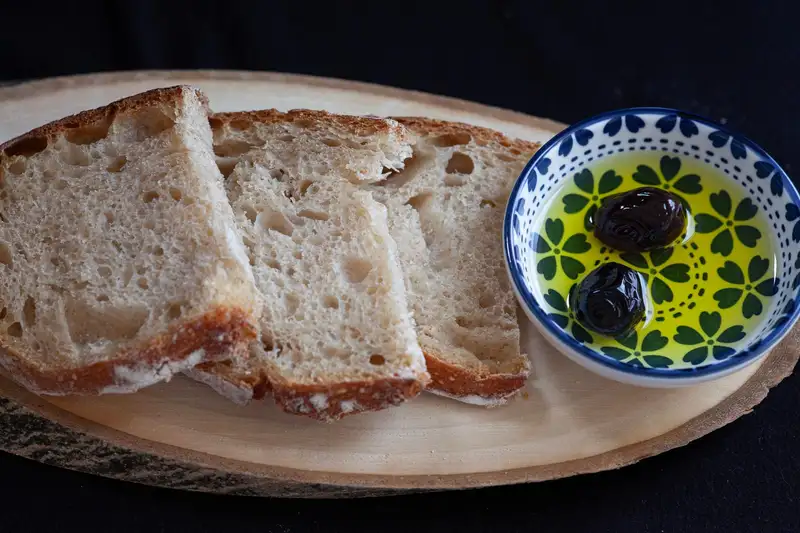
It might be over a wood fire in the corner, on a grill outside, or in a small oven. The bread is a plain, crusty loaf, cut thick. It gets toasted, rubbed with a raw garlic clove, given a pinch of salt, and then soaked with oil straight from the spout. In Lazio this is bruschetta. Over the border in Tuscany you will hear fettunta.
That first bite is the reason a lot of people put up with the long day. New oil is not gentle. It's grassy and bitter, and it catches at the back of your throat with a peppery sting. Some people cough. Locals take that as a good sign. That bite fades over the next months, and the oil turns smoother.
Visitors often think something is wrong the first time. The oil is cloudy, it's too strong, it burns. In fact that is just what new oil tastes like. The clear, mild oil you buy in many shops back home is often older, filtered, or blended, and it has lost that edge.
Olio nuovo at home
For a few weeks after the harvest, new oil goes on everything. Bruschetta, of course. A bean soup with a thread of oil on top. Boiled greens with oil and lemon. A plate of chickpeas. Grilled meat. A bowl of plain pasta with oil, garlic and chili. It is the season's treat, and it costs nothing more than the work.
People are careful with it, too. Oil keeps best away from light, heat and air. That is why it lives in steel cans or dark glass, in a cool room, and why a family will pour it off into smaller bottles a little at a time.
The oil also travels. A family that picked together will often split the oil, so the cousins in Rome go home with a can in the car. Some goes to a friend who lent a ladder. Some goes to a neighbor who is too old to pick this year. You can learn a lot about a family by asking where its oil goes.
The rest of the year in the grove
The harvest gets the attention, but the grove asks for work all year.
In late winter and spring, the trees get pruned. Olive trees are cut open in the middle so light and air can get in, and a good pruner is respected the way a good cook is. People argue about pruning almost as much as they argue about when to pick. Cut too much and you lose a year of fruit. Cut too little and the tree gets thick and tired. The branches that come off are often piled up and burned, where the rules allow, and that smoke is one of the smells of a Tuscia spring.
Then there is the grass to cut, the walls to fix on terraced slopes, and the long summer wait. Families keep an eye out for the olive fly in the warm months. They look at the fruit in August and September and start to guess what kind of year it will be. By October, the talk at the bar turns to olives. Who is starting when. Which mill is the busiest. Whether the cold will hold off.
So when the nets finally go down, it is the end of a long year, and the start of a short, busy one.
Oil with a place name
Tuscia oil has standing of its own. The area has protected oil names, Canino and Tuscia among them, that tie an oil to where it was grown and how it was made. A local olive called Caninese is common here, along with types like Frantoio, Leccino and Pendolino that you'll find across central Italy.
For most families picking their own trees, though, the label is not the point. Their oil is "ours." It's the oil from the trees below the house, or the grove by the old road. They know how it tasted last year and the year before. They taste it the way you might taste your own family's tomato sauce.
What visitors tend to miss
A few things come up often.
This is food, not a pastime. It can look like a nice day out. For many families, it's the year's cooking oil, the gift they give and the link to a piece of land they won't sell.
Timing is local. People ask for "the harvest date." There isn't one. Each grove goes when it's ready and when the family can get there. Late October to the end of November is the safe bet.
The mill is the social hub. If you want to see the season, the grove is only half of it. The frantoio at night, with the line of cars and the fire and the bread, is the other half.
Some visitors get closer than watching. One example of immersive travel spends harvest week in Soriano nel Cimino, up in the Cimini hills, where guests climb into the trees with local friends and then follow their olives to the mill.
Fresh oil is a season. Olio nuovo is a moment, a few weeks a year. Then it becomes just oil, still very good, and the family uses it until next November.
The harvest in its wider year
In the Cimini hills, the olive harvest sits in a crowded season. Hazelnuts come in late summer. Grapes come in September and October. Chestnuts fall in October. Then the olives. Families here often grow more than one of these, so autumn can feel like one long harvest that just changes crops. If you want to see how the hazelnut side of it works, there's a piece on the hazelnut harvest in Soriano's countryside. For the wine, see wine cellar gatherings in the Cimini area.
The hills are also lovely to walk in this season, with the woods turning and the lake often under fog in the morning. If you plan to hike while you're there, this guide to Monte Cimino trails in autumn covers the planning side.
What the oil holds
Watch a family at the end of a harvest day and you see something that is easy to miss. They are tired. Their hands are stained and their backs hurt. They have spent hours on ladders and more hours in a line at the mill. And then they stand around a fire in the cold and tear at toast dripping with green oil, and everyone is in a good mood.
The oil is food. It's also a record. It holds that year's weather, that grove's soil and the work of people who came back to do it together. When a family pours it over a bowl of beans in February, they are tasting that day in the grove. That is what keeps them coming back to trees that, in money terms, barely pay their way. The trees are theirs, and so is the day.


Comments (0)
No comments yet. Be the first!